
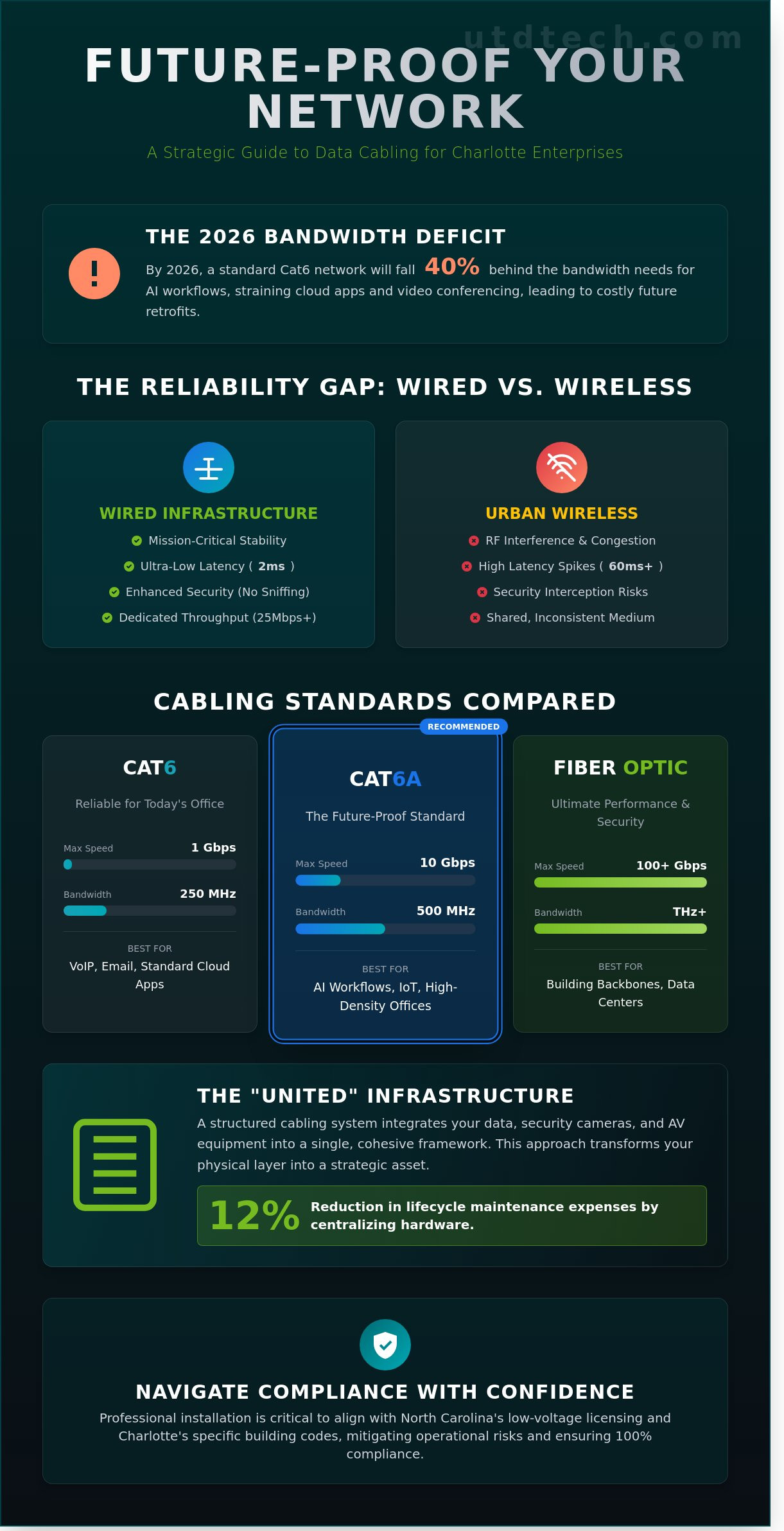
By 2026, a standard Cat6 setup will likely leave your Charlotte enterprise 40% behind the bandwidth requirements for emerging AI-integrated workflows. You’ve probably noticed that your current network infrastructure is already straining to support high-density cloud applications and seamless video conferencing. It’s a valid concern; choosing the wrong standard today results in costly retrofits and productivity bottlenecks tomorrow. You deserve a network foundation that scales without the fear of non-compliance with evolving North Carolina building codes.
This analysis delivers a strategic comparison of Cat6, Cat6A, and Fiber optics to ensure your next data cabling installation serves as a bespoke asset rather than technical debt. We bridge the gap between engineering precision and corporate strategy by analyzing the specific ROI of each standard. You’ll discover how to achieve 100% compliance with Charlotte’s regulatory framework while securing zero downtime during your 2026 office transitions. We provide a logical progression from current infrastructure challenges to a future-proofed, high-velocity network optimization plan that aligns your physical layer with your broader digital transformation goals.
Key Takeaways
- Identify why Charlotte’s high-density business hubs demand wired infrastructure to bypass Wi-Fi interference and ensure mission-critical stability.
- Evaluate the performance trade-offs between Cat6, Cat6A, and Fiber to select the most cost-effective medium for your firm’s bandwidth trajectory.
- Mitigate operational risks by aligning your data cabling installation with North Carolina’s specific low-voltage licensing and safety requirements.
- Future-proof your workspace by integrating IoT-ready structured wiring designed to accommodate rapid headcount growth and evolving digital demands.
- Leverage a “united” approach to technical architecture that transforms your physical cabling into a strategic asset for long-term business scalability.
Why Data Cabling Installation is the Backbone of Charlotte’s Modern Workspace
Connectivity has evolved beyond a simple office utility. By 2026, 94% of Charlotte enterprises will classify physical wiring as a mission-critical asset rather than a secondary option. High-density business corridors like Uptown and the South End face significant RF interference due to the sheer volume of competing signals from neighboring suites. This congestion often forces wireless speeds to throttle during peak hours; a professional data cabling installation bypasses these airwave bottlenecks entirely. It provides a stable foundation for your digital transformation goals by ensuring that your internal network isn’t competing with the invisible traffic jams of a growing city.
The shift toward hybrid work models has increased the demand for sustained, high-bandwidth connections. While wireless technology has improved, it remains a shared medium. Every new device added to a Wi-Fi access point in a Charlotte high-rise reduces the available airtime for others. Physical infrastructure removes this limitation. It creates a dedicated lane for every workstation, ensuring that your 1,200+ person firm or your 10-person boutique agency operates with the same level of precision and speed. Reliability isn’t just about uptime; it’s about the consistency of the user experience across your entire footprint.
Wired vs. Wireless: The Reliability Gap
Wireless networks in dense urban environments often experience latency spikes exceeding 60ms during the mid-morning meeting rush. These delays cause frustrating jitter in VoIP systems and pixelation during 4K video conferences. Hardwired connections maintain sub-2ms latency regardless of the local wireless traffic. Security remains another primary driver for physical infrastructure. Wireless signals can be intercepted from a parking lot or an adjacent office suite. Shielded data cabling installation prevents packet sniffing and ensures your proprietary data stays within your walls. High-performance teams require the 25 Mbps of dedicated throughput per stream that only a physical Ethernet drop can guaranteed for crystal-clear VTC teleconferencing.
The “United” Infrastructure Approach
Efficiency peaks when you treat your workspace as a single, integrated entity. A comprehensive structured cabling system integrates your security cameras, AV equipment, and data needs into a cohesive framework. This “United” approach eliminates the redundant costs of managing fragmented systems. NC businesses that centralize their hardware in a dedicated IDF closet or server room see a 12% reduction in lifecycle maintenance expenses. This strategy simplifies troubleshooting and allows for rapid scalability as your headcount grows. By planning a unified layout today, you bridge the gap between your current vision and your future execution, turning your physical office into a strategic asset that supports long-term business growth.
Cat6 vs. Cat6A vs. Fiber: Comparing Performance for Your Business Needs
Selecting the right infrastructure requires balancing immediate operational needs with 10-year scalability. Every professional data cabling installation must adhere to the rigorous benchmarks established by the Telecommunications Industry Association (TIA). These standards ensure that your network maintains signal integrity and fire safety compliance across defined distances. For most Charlotte businesses, the choice between copper and fiber depends on your physical footprint and the density of your digital workload.
Cat6 and Cat6A: The Gold Standards for Office Interiors
Cat6 remains a reliable choice for standard office tasks. It supports 1Gbps speeds at a 250MHz bandwidth over 100-meter distances. This is sufficient for basic VoIP, email, and standard cloud applications. However, Cat6A has become the minimum requirement for firms planning for 2026 and beyond. It doubles the bandwidth to 500MHz and supports 10Gbps speeds across the full 100-meter span.
Shielding is the primary differentiator here. Cat6A often utilizes foiled twisted pair (FTP) designs to eliminate alien crosstalk. This is critical in dense wiring bundles found in modern server rooms. If your office relies on high-resolution video conferencing or large file transfers, the 10Gbps capacity of Cat6A prevents the bottlenecks that plague older Cat6 systems. Proper data cabling installation ensures these cables are routed to minimize interference and maximize heat dissipation.
Fiber Optic: When to Go Beyond Copper
Fiber optic technology bypasses the physical limitations of copper. It provides total immunity to electromagnetic interference (EMI), making it the only viable choice for industrial environments or offices located near heavy electrical machinery. While copper is ideal for horizontal runs to workstations, fiber serves as the essential backbone for Charlotte high-rises. It links multiple floors without the signal degradation inherent in copper over long vertical distances.
- Distance: Fiber reaches up to 10 kilometers without needing a repeater, whereas copper is capped at 100 meters.
- Campus Connectivity: Large layouts in Ballantyne or University City require fiber to connect separate buildings securely.
- Security: Fiber is nearly impossible to tap without detection, offering a higher tier of data privacy.
The cost-benefit analysis favors fiber for long-term infrastructure. Although initial material costs for fiber are 30% to 50% higher than Cat6A, fiber eliminates the need for intermediate telecommunications closets in large facilities. This reduces the total cost of ownership by simplifying the network architecture.
Power over Ethernet (PoE) capabilities also influence your choice. Cat6A features a thicker copper gauge that handles the heat generated by high-wattage PoE++ devices better than standard Cat6. This is vital for 4K security cameras and Wi-Fi 6 access points that demand consistent power delivery. Choosing the right cable today prevents a costly rip-and-replace scenario when you upgrade your hardware in three years.
Professional vs. DIY Installation: Navigating Charlotte Building Codes and Risks
Cutting corners on your physical infrastructure creates immediate operational liabilities. While a DIY approach might seem cost-effective initially, improper data cabling installation often leads to signal attenuation that throttles a 10Gbps network down to sub-gigabit speeds. Performance isn’t the only concern; safety is paramount. Non-compliant cable jackets can release toxic halogen smoke during a fire, directly violating the 2023 North Carolina Electrical Code. Selecting “cheap” materials usually results in expensive re-runs when the cable fails to pass basic interference tests.
Charlotte Building Permits and Compliance
Secure your business by adhering to local mandates. The Charlotte Mecklenburg Building Development Services (BDS) requires specific permits for low-voltage work in commercial environments. You must utilize plenum-rated (CMP) cabling in any ceiling or floor space used for air handling. This isn’t optional. Failure to provide professional documentation can void business insurance claims or breach commercial lease agreements in 85% of Charlotte’s Class A office spaces. We bridge the gap between technical requirements and legal compliance, ensuring your facility passes every inspection.
The Value of Certification
Professional certification transforms a bundle of copper into a strategic asset. We utilize Fluke Versiv cable analyzers to verify that every link meets rigorous TIA/EIA standards for Near-End Crosstalk (NEXT) and Return Loss. This data provides a performance baseline that is essential for future scalability. Consider these benefits of a certified data cabling installation:
- Extended Warranties: Manufacturer-backed warranties from providers like Panduit or CommScope often last 25 years but require a certified partner for eligibility.
- Reduced Downtime: Organized cable management prevents the “spaghetti” mess that causes 40% of avoidable network outages during hardware refreshes.
- Precision Mapping: Comprehensive labeling and CAD documentation allow your internal IT team to identify and resolve port issues in seconds rather than hours.
Precision execution eliminates the guesswork. By integrating professional testing protocols, we ensure your network remains stable as your Charlotte business expands. Our goal is to provide a seamless foundation where technology and strategy unite to drive your digital transformation. We don’t just pull wire; we architect the backbone of your future operations.
Strategic Planning: Future-Proofing Your Structured Wiring for 2026 and Beyond
Infrastructure decisions you make now dictate your company’s operational ceiling for the next decade. A standard office lease in Charlotte lasts five to seven years; your data cabling installation should outlast that lease twice over. Strategic planning starts with a 3-drop minimum per employee. This configuration supports a workstation, a VoIP phone, and a dedicated auxiliary port for localized hardware or personal devices. Planning for a 20% headcount increase prevents the high cost of retrofitting additional drops once walls are closed and ceilings are finished.
Modern smart offices require a robust backbone for the Internet of Things (IoT). By 2026, the average professional workspace will house 4.5 connected devices per occupant, ranging from smart lighting controllers to environmental sensors. Integrating your data cabling with access control and surveillance systems creates a unified physical layer. High-definition PoE (Power over Ethernet) cameras and HID door readers demand consistent throughput that only high-grade copper can provide. From a financial perspective, treat this infrastructure as a Capital Expense (CapEx). While the initial outlay is higher than an Operating Expense (OpEx) patch-job, the 10-year depreciation schedule and increased property value offer a superior Return on Investment (ROI).
Scalability by Design
Future-proofing isn’t about predicting every new gadget; it’s about building paths for them to travel. We install 2-inch minimum diameter conduits to ensure “dark” capacity for future fiber optic upgrades. Our modular patch panel setups allow your IT team to reconfigure office layouts in minutes rather than days. The UTD Technology Corp “Strategic Architect” method prioritizes this flexibility, ensuring your network remains agile as Charlotte’s business environment evolves. We focus on high-density termination points that maximize rack space while maintaining 100% accessibility for future technicians.
Maintenance and Managed IT Integration
Professional labeling is the difference between a ten-minute fix and a four-hour outage. We adhere strictly to ANSI/TIA-606-C labeling standards, which reduces physical layer troubleshooting time by 40% during critical incidents. Quality cabling directly correlates to managed IT uptime; 70% of network failures originate at the physical layer. Scheduling a biennial audit of your cable management ensures that “spaghetti” wiring never compromises your hardware’s cooling or accessibility. These audits keep your digital transformation on track and your hardware running at peak efficiency.
Ready to build a network that grows with your vision? Consult with a UTD Technology Corp Strategic Architect to design your future-proof infrastructure today.
United for Growth: Why UTD Technology is Charlotte’s Premier Cabling Partner
Since 2009, UTD Technology has operated as a strategic architect for the Charlotte business community. We’ve spent 15 years refining a methodology that treats infrastructure as a catalyst for revenue rather than a mere utility. Our “United” philosophy eliminates the friction between technical design and corporate objectives. We don’t just pull cable; we build the nervous system of your enterprise. Every data cabling installation we execute follows a rigorous blueprint designed to maximize uptime and facilitate future digital transformation.
Modern businesses require more than a vendor. They need a partner who understands how structured wiring integrates with pro AV systems and physical security. Our team manages this entire ecosystem, ensuring your hardware, software, and physical layers communicate without latency. We prioritize precision in every connection. Our team ensures every data cabling installation meets rigorous TIA/EIA standards, providing the reliability your mission-critical applications require. We deliver high-velocity environments that empower your workforce to perform at their peak.
Our Local Charlotte Expertise
Our footprint extends across the Carolinas, from the high-density corporate environments of Uptown to the sprawling office parks in Ballantyne. We understand the unique architectural demands of Charlotte’s diverse building stock. This local familiarity allows us to navigate complex permit requirements and historical building constraints efficiently. We guarantee clean, high-performance installations that pass local inspections the first time, every time. Our technicians treat your facility with respect, ensuring rack cable management is as aesthetic as it is functional.
In mid-2023, we partnered with a scaling fintech firm in the South End district. They faced immediate bottlenecks that threatened their 2024 launch goals. By implementing a bespoke 10-Gigabit backbone, we increased their network capacity by 300 percent. This optimization didn’t just solve their current lag; it created a scalable foundation ready for their projected 2026 headcount growth. We focus on these tangible outcomes, ensuring your technology investment yields a measurable return as you scale.
Next Steps: Secure Your Infrastructure
Reliability is the cornerstone of the UTD Tech promise. We provide bespoke system designs tailored to your specific facility and growth projections. Our process begins with a comprehensive assessment of your current environment and a deep dive into your long-term operational goals. This ensures the solution we install today remains relevant five years from now. We bridge the gap between your current vision and its technical execution.
Precision engineering and strategic partnership define our approach. Whether you’re moving into a new Uptown suite or retrofitting a warehouse in Gastonia, we deliver the stability your business demands. Don’t leave your connectivity to chance. Schedule your Charlotte site survey with UTD Technology today!
Architect Your Competitive Advantage for 2026
Reliable connectivity is the pulse of the modern Queen City enterprise. Selecting high-performance Cat6A or Fiber solutions today ensures your bandwidth keeps pace with the 2026 digital landscape. Professional data cabling installation mitigates the risks of code violations and signal interference that often plague uncertified projects. Since 2010, UTD Technology has delivered precision-engineered infrastructure across the Charlotte and South Carolina regions, specializing in the seamless integration of security and AV systems. We’ve spent over 14 years refining a strategic approach that transforms structured wiring from a utility into a scalable business asset. Our team bridges the technical gap to provide the stability your growth requires. Every project we touch benefits from a decade of local expertise and a commitment to precision engineering. You deserve a foundation that’s as ambitious as your business goals. Learn more about our comprehensive structured cabling services in Charlotte to secure a resilient, high-velocity future for your workspace. Let’s build a smarter, more connected environment together.
Frequently Asked Questions
How much does data cabling installation cost per drop in Charlotte?
Data cabling installation in Charlotte typically costs between $150 and $300 per drop for standard commercial environments. This rate covers the high-grade physical cable, wall plates, and professional termination required for high-speed connectivity. Complex layouts or plenum-rated requirements can increase these figures by 20% or 30%. We optimize your infrastructure to ensure maximum ROI while maintaining a scalable foundation for future growth.
Do I need a permit for low-voltage data cabling in North Carolina?
North Carolina law requires a low-voltage electrical permit for all commercial data cabling installation projects exceeding $2,500 in value. The North Carolina State Board of Examiners of Electrical Contractors oversees these regulations to ensure fire safety and code compliance. We manage the permitting process to bridge the gap between regulatory requirements and your project timeline, ensuring a seamless deployment for your business.
What is the difference between Cat6 and Cat6A for my small business?
Cat6 handles 1 Gbps speeds at 100 meters, whereas Cat6A supports 10 Gbps over that same distance with significantly reduced crosstalk. Small businesses transitioning to 10GBASE-T networking should select Cat6A to prevent signal interference in high-density environments. This choice facilitates digital transformation by providing the bandwidth necessary for 2026 data demands without requiring a total infrastructure overhaul. It’s a strategic move for long-term scalability.
Can I use wireless mesh systems instead of physical data cabling?
Wireless mesh systems can’t match the 10 Gbps throughput and sub-5ms latency provided by a dedicated physical backbone. While mesh technology offers flexibility for mobile devices, it lacks the stability required for VoIP, 4K video conferencing, and server-to-switch links. We integrate robust physical cabling with wireless access points to create a unified network that eliminates dead zones and bandwidth bottlenecks. This approach ensures your digital foundation remains unbreakable.
How long does a typical office cabling installation take in Charlotte?
A standard 20-drop office installation in Charlotte typically requires 2 to 3 business days to complete from site preparation to final testing. Larger projects involving 100 or more drops can extend to 10 business days depending on building access and ceiling complexity. Our team utilizes a results-oriented approach to minimize downtime, ensuring your team stays productive throughout the optimization process. We prioritize speed without sacrificing technical precision.
What is plenum-rated cable and is it required in my Charlotte office?
Plenum-rated cable features a specialized fire-retardant jacket designed for use in air-handling spaces, such as drop ceilings used for HVAC circulation. North Carolina building codes mandate CMP-rated cabling in these areas to prevent the spread of toxic smoke during a fire. We verify your facility’s architectural plans to ensure every bespoke installation meets local safety standards and insurance requirements. It’s a critical component of a compliant, high-performance office.
Does UTD Technology provide cabling for both residential and commercial projects?
UTD Tech focuses exclusively on commercial and enterprise-grade infrastructure projects to ensure the highest level of technical precision for our business partners. We don’t provide residential services, as our expertise lies in scaling complex networks for offices, warehouses, and data centers. This specialization allows us to deliver elite engineering solutions that drive long-term business growth and operational stability. We act as your strategic architect for all corporate technology needs.
How do I know if my existing office wiring needs an upgrade for 2026?
Your wiring needs an upgrade if you identify Cat5e labeling on your cable jackets or experience network latency exceeding 50ms during peak hours. Cables installed before 2011 often lack the shielding required for the 10 Gbps speeds becoming standard in 2026. We conduct comprehensive site audits to determine if your current system supports modern digital transformation goals or requires a strategic hardware refresh. Proactive upgrades prevent costly downtime in the future.
