
Why invest $5,000 in a premium 4K projector only to watch it struggle against the 218 days of intense Charlotte sunshine that flood your living room? Most homeowners assume heavy blackout curtains are the only solution for a washed-out image, but the real bottleneck is often the screen surface itself. A high gain projector screen acts as a strategic amplifier; it reflects more light directly toward the viewer to maintain 4K clarity even in multi-purpose spaces with high ambient light. This technology optimizes your brightness levels by a factor of 1.5 or more, ensuring your hardware performs exactly as the manufacturer intended during a bright North Carolina afternoon.
You’ve likely felt the frustration of a ghostly image during a Sunday kickoff or worried that a brighter screen would result in distracting hotspots and narrow viewing angles. It’s a common technical hurdle that often stalls high-end home theater projects. We’ll show you how to choose the precise gain level for your specific environment and bridge the gap between confusing technical specs and actual visual performance. This guide provides a strategic roadmap to achieve a clear, bright image through professional integration that respects your home’s design and your desire for peak performance.
Key Takeaways
- Understand how a high gain projector screen strategically redirects light to preserve image intensity in Charlotte environments with significant ambient light.
- Identify the critical technical differences between light-boosting high gain surfaces and light-blocking ALR screens to select the optimal solution for your space.
- Navigate the optical trade-offs of increased brightness, including how to manage viewing angles and prevent hotspotting through precise engineering.
- Apply a professional framework to calculate the necessary gain based on your projector’s lumen output and the physical dimensions of your installation.
- Explore the advantages of a unified system where your screen is seamlessly integrated with Control4 and advanced home automation for effortless control.
What is a High Gain Projector Screen and Why Does it Matter in Charlotte?
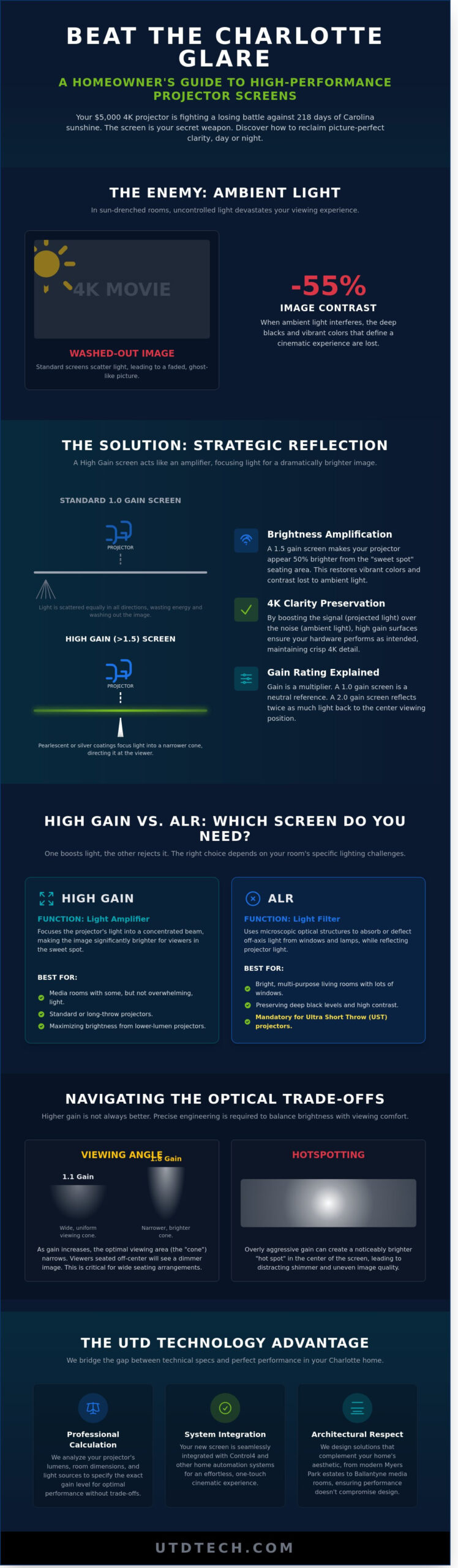
Home cinema enthusiasts in Charlotte often face a common enemy: ambient light. A high gain projector screen acts as a strategic solution to this challenge. It optimizes visual performance by narrowing the angle of light reflection. Instead of scattering light across the room, these screens concentrate the image brightness toward the primary seating area. This isn’t just about a brighter picture; it’s about preserving the emotional weight of a film. When contrast ratios drop by 55% due to light interference, the cinematic experience feels hollow. High gain technology restores that depth, ensuring your investment in a high-lumen projector isn’t wasted on a faded display.
The Science of Light Reflectivity
Industry standards define a 1.0 gain as the baseline, representing a standard matte white surface that reflects light equally in all directions. Selecting a screen with a 1.5 to 2.5 gain rating effectively multiplies the perceived brightness of your projector for anyone sitting in the “sweet spot.” Specialized coatings, such as pearlescent or silver-based layers, enhance color saturation by filtering out off-axis light. Understanding What is Screen Gain? helps homeowners determine the precise reflectivity needed for their specific hardware. High gain is an optical measurement of light redirection toward a central viewing point. This technical optimization ensures that colors remain vibrant even when you don’t have total control over the environment.
Charlotte Architectural Challenges
Modern homes in neighborhoods like Myers Park and Ballantyne feature expansive floor plans and floor-to-ceiling windows. These architectural choices create beautiful living spaces but present significant hurdles for traditional projection setups. Standard screens often fail in these sun-drenched sunrooms because they can’t compete with the thousands of lumens of natural sunlight pouring in during a summer afternoon. High gain screens provide the necessary compensation for “light bleed” to create a seamless media room experience. While a dedicated “dark room” theater utilizes controlled lighting, most Charlotte residents prefer “media room” setups that integrate into their daily lives. We bridge the gap between architectural aesthetics and high-performance entertainment through these bespoke screen surfaces. Success in these environments requires a calculated approach to light management:
- Redirecting Reflection: High gain surfaces focus light toward the viewer rather than the walls.
- Ambient Light Rejection: Advanced coatings help absorb light coming from the side windows.
- Contrast Enhancement: Maintaining deep blacks in rooms with 20% or more ambient light leakage.
Optimizing your viewing environment requires more than just a powerful projector. It demands a surface engineered to handle the specific light profile of your Charlotte home. By selecting the right gain, you transform a washed-out image into a professional-grade display that maintains its integrity regardless of the time of day.
High Gain vs. ALR (Ambient Light Rejecting) Screens
Selecting the wrong surface ruins a high-end projector’s potential. A high gain projector screen functions as a light amplifier, focusing the projector’s output into a narrower viewing cone to increase perceived brightness. In contrast, ALR technology acts as a physical filter. One adds energy to the reflection; the other preserves the image by neutralizing environmental interference. Choosing between them requires an analysis of your room’s light geometry and the desired viewer experience.
ALR Technology Explained
ALR surfaces utilize microscopic triangular ridges or lenticular layers to manage light directionally. These structures are engineered to catch light coming from the projector’s specific angle while absorbing or deflecting light from the ceiling and side windows. This capability makes ALR the mandatory choice for Ultra Short Throw (UST) projectors, where the light source sits just inches below the screen at a steep 45-degree angle. While a high gain projector screen might produce a “shimmer” or a visible hot-spot in the center, ALR screens prioritize black levels. They create a “darkening” effect that maintains deep contrast even when the lights stay on, mimicking the look of a massive flat-panel television.
Choosing the Right Tool for the Job
Massive Charlotte boardrooms often require displays exceeding 150 inches. In these cavernous spaces, light must travel long distances, making high gain materials essential for maintaining image punch. Residential media rooms with large side windows demand ALR to prevent washed-out colors during daytime viewing. By 2026, professional projector models will likely target 50 to 80 Foot-lamberts for high-impact commercial displays to compete with daylight. Adhering to AV installation standards allows our engineers to calculate the exact gain needed to hit these specific brightness benchmarks without sacrificing color accuracy.
- High Gain: Best for dedicated theaters and large-scale corporate auditoriums with controlled lighting.
- ALR: Best for multi-purpose “flex” spaces, living rooms, and bright retail environments.
- Hybrid Solutions: Specialized “dark” high-gain screens offer a 1.5 gain while rejecting 70% of ambient light.
Budgeting for these technologies requires a strategic view of long-term value. High-end ALR materials typically command a 30% to 40% price premium over standard matte white surfaces. For Charlotte businesses, this investment pays off through increased engagement during presentations where participants don’t have to sit in the dark. Residential users benefit from a setup that remains functional at any time of day. Optimizing your visual stack requires a bespoke integration strategy that balances your hardware’s lumen output with the physical realities of your environment.
The Trade-offs: Understanding Hotspotting and Viewing Angles
Engineering excellence requires acknowledging that optical performance follows the Law of Conservation of Energy. A high gain projector screen doesn’t create light; it redirects it. You gain brightness in a tight central area by sacrificing luminosity at the periphery. This trade-off creates two primary challenges: hotspotting and narrow viewing cones. Understanding these Projection screen basics ensures your theater investment delivers a consistent experience for every seat in the room. Professional calibration minimizes these inherent material weaknesses by balancing the projector’s output against the screen’s specific reflective properties, optimizing the final image for your specific environment.
Managing the Viewing Cone
The “Half-Gain Angle” defines the point where the image appears 50% dimmer than it does from the center seat. For a high gain projector screen, this angle is often as narrow as 30 degrees. Charlotte home theater designs frequently feature wide, open-concept rooms exceeding 22 feet in width. If your seating layout places viewers on a side sofa outside this cone, they’ll see a significantly degraded image compared to those in the “sweet spot.”
Precision alignment is the only way to mitigate this. Align the projector lens exactly perpendicular to the screen’s horizontal center to ensure the peak brightness remains focused on the primary seating cluster. In 90% of high-end installations, even a three-inch deviation in lens placement can shift the viewing cone enough to leave the far-left or far-right seats in the dark.
Combatting Hotspotting
Hotspotting occurs when the screen material reflects light too directionally back to the source. This phenomenon manifests as a bright, glowing patch in the center of the screen while the corners appear noticeably darker, sometimes by a margin of 40% or more. The intensity of this effect is directly linked to your projector’s throw distance. A short throw ratio, such as 1.2:1, forces light to hit the screen at extreme angles, which exacerbates the uneven reflection.
- Maintain a throw ratio of at least 1.8:1 to flatten the light distribution across the material.
- Utilize curved screen frames for 2.40:1 Cinemascope setups to physically angle the edges toward the audience.
- Select bespoke screen coatings designed to diffuse light more effectively while maintaining gain.
Curved screens are a strategic solution for 150-inch displays or larger. By curving the screen, you ensure that the light from the projector hits the edges at an angle closer to 90 degrees. This physical adjustment reflects more light back to the viewers and less into the side walls, creating a seamless visual field that feels uniform from edge to edge.
Selection Guide: Matching Gain to Your Charlotte Media Room
Selecting the right high gain projector screen requires a technical alignment between your projector’s output and the specific environment of your Charlotte home. It’s not a one-size-fits-all decision. High-performance media rooms rely on calculated light reflection to overcome ambient light and maximize dynamic range. This process transforms a standard viewing area into a professional-grade cinema.
Engineers prioritize the foot-lambert (fL) measurement to determine visual impact. Aim for a target brightness of 30 to 50 fL for a vibrant experience. Calculate this by multiplying your projector’s calibrated lumens by the screen gain, then dividing by the total square footage of the screen. Larger 150-inch displays disperse light over a 60% greater area than 100-inch models. This dispersion necessitates higher gain to maintain peak luminance and prevent the image from appearing washed out.
Environmental factors in North Carolina also dictate material choice. Charlotte’s average morning humidity reaches 84% during summer months, which can cause inferior screen materials to stretch or ripple. A high gain projector screen built with premium PVC vinyl and reinforced backing provides the necessary resilience. For permanent installations in non-climate-controlled spaces like sunrooms, rigid panels offer superior dimensional stability. These panels eliminate the risk of “waves” and provide a consistent surface for high-gain coatings.
The Lumens-to-Gain Ratio
Use a digital light meter to measure the exact lux levels in your room before purchasing. This data prevents “over-gaining,” a common error where the screen is too bright for the seating distance. Excessive gain in smaller rooms leads to hot-spotting and visual exhaustion. Precision calibration ensures the screen enhances the image without overwhelming the viewer’s optics or sacrificing black levels.
Fixed Frame vs. Motorized Solutions
Fixed frames provide the most stable surface for high-gain materials. However, motorized screens offer essential flexibility for multi-purpose Charlotte lofts where a visible screen might disrupt the aesthetic. Ensure any retractable model features a tab-tensioning system to keep the surface perfectly taut. Seamlessly integrate these units with structured wiring to centralize control and power management within your home’s technical infrastructure.
Professional Integration: The UTD Technology Advantage
A high gain projector screen delivers peak performance only when integrated into a unified ecosystem. At UTD Technology, we view the screen as one variable in a complex engineering equation. If your screen gain is 1.5 but your ambient light control is non-existent, the investment fails. We bridge this gap by synchronizing hardware with the surrounding environment. Our Charlotte installations focus on the “United” aspect of our brand; we ensure that optics, acoustics, and automation work in a single, cohesive loop. Professional mounting goes beyond aesthetics. We calculate the exact “half-gain angle” to ensure every seat in your home theater experiences the same 3000:1 contrast ratio.
Automation and Control
Modern luxury homes require more than a simple remote. We program Control4 systems to execute “Cinema Scenes” with a single touch. This command lowers the high gain projector screen, dims Lutron lighting to exactly 5%, and activates the 7.2.4 Dolby Atmos system simultaneously. Our integration strategy includes:
- Smart Sensors: We install photo-sensitive triggers that monitor lux levels in real-time. If the afternoon sun hits a window in your Myers Park home, the system automatically lowers motorized shades to preserve image clarity.
- Projector Calibration: We link the screen triggers to the projector’s lamp mode, adjusting brightness levels based on the time of day or the specific content being viewed.
- Security Syncing: Your audio-visual distribution connects directly to whole-home security. If a perimeter sensor trips, the screen retracts and the projector pauses, instantly switching the display to your 4K camera feeds.
The UTD Tech Strategic Approach
We treat every Charlotte media room as a bespoke digital ecosystem. Our engineers utilize laser-guided alignment tools to achieve 99.8% geometric accuracy during the mounting process. This precision prevents hot-spotting, a common issue where high gain surfaces reflect light unevenly. We don’t just install and leave. We provide a 12-month post-installation optimization window to recalibrate systems as components settle and software updates occur. This commitment to precision engineering ensures your system remains as reliable on day 500 as it was on day one.
Optimize Your Vision with Strategic AV Engineering
Achieving a pristine image in a sun-drenched Charlotte living room requires more than just high-end hardware. It demands a calculated approach to light physics. Selecting the right high gain projector screen effectively doubles your brightness levels while maintaining color accuracy in high-ambient light environments. You’ve learned that balancing gain with viewing angles prevents hotspotting, ensuring every seat in your media room offers a premium perspective. Strategic placement and precise calibration turn a standard room into a high-performance cinema.
UTD Technology bridges the gap between complex engineering and seamless home entertainment. As a Certified Control4 Dealer with over 15 years of Charlotte AV expertise, we provide full-service design and installation tailored to your specific architectural needs. We don’t just sell equipment; we architect bespoke environments that prioritize long-term stability and performance. Our team handles every technical detail so you can focus on the content. Upgrade your Charlotte home theater with UTD Tech today. Let’s build a visual experience that stands the test of time and light.
Frequently Asked Questions
Is a high gain screen better for 4K projectors?
High gain screens aren’t a universal requirement for 4K projectors, as resolution and brightness serve different performance metrics. You’ll achieve peak 4K clarity by matching your projector’s lumen count to the screen’s reflective properties. A 2,500-lumen Sony 4K unit paired with a 1.3 gain surface ensures HDR highlights pop without washing out the 3,840 x 2,160 pixel detail.
Can I use a high gain screen for outdoor movies in Charlotte?
You can use a high gain screen for outdoor movies in Charlotte to combat the city’s light pollution and late summer sunsets. A screen with a 1.5 gain rating reflects 50% more light than a standard matte white surface. This boost is critical if you’re starting a screening at 8:15 PM before the sun fully sets behind the Charlotte skyline.
What is the best gain for a room with some ambient light?
A gain range of 1.1 to 1.5 provides the best balance for rooms with moderate ambient light. This configuration directs light back toward the viewing area rather than scattering it. We recommend a 1.3 gain surface to maintain a 1,000:1 contrast ratio when competing with standard residential window treatments or recessed LED lighting.
Do high gain screens affect color accuracy?
High gain screens can compromise color accuracy by introducing “hot spotting” or shifting hues when viewed from wide angles. While a high gain projector screen increases brightness, it often narrows the viewing cone to 30 degrees. Beyond this 30-degree threshold, you may notice a 12% decrease in color saturation as the reflective coating prioritizes light intensity over chromatic precision.
How do I clean a high gain projector screen safely?
Clean your screen using a dry microfiber cloth and avoid all harsh chemical solvents. If a stain persists, apply a solution of 99% distilled water and 1% mild dish soap to a localized area. Rubbing too hard destroys the delicate optical coating that provides the gain, potentially reducing the screen’s reflective efficiency by 20% in the treated spot.
Are high gain screens more expensive than standard white screens?
High gain screens typically carry a 25% price premium over standard matte white alternatives. This cost reflects the complex manufacturing process required to apply specialized reflective layers or glass beads to the substrate. Investing in a high gain projector screen is a strategic move for Charlotte media rooms where total light control isn’t achievable through architectural means alone.
Can a high gain screen work with an Ultra Short Throw (UST) projector?
Most high gain screens are incompatible with Ultra Short Throw (UST) projectors due to the steep angle of the light source. A UST projector sitting just 10 inches from the wall requires an Ambient Light Rejecting (ALR) screen with a specialized sawtooth texture. Standard high gain surfaces will reflect that light toward the ceiling rather than your seating position, wasting 90% of the projector’s output.
What happens if I use a high gain screen in a completely dark room?
Using a high gain screen in a completely dark room often results in excessive brightness that causes eye fatigue during long viewing sessions. A 2.0 gain screen in a 0-lux environment creates a “hot spot” where the center of the image appears significantly brighter than the edges. This imbalance disrupts the visual experience and can wash out deep black levels by 15%, undermining your projector’s native contrast.
